
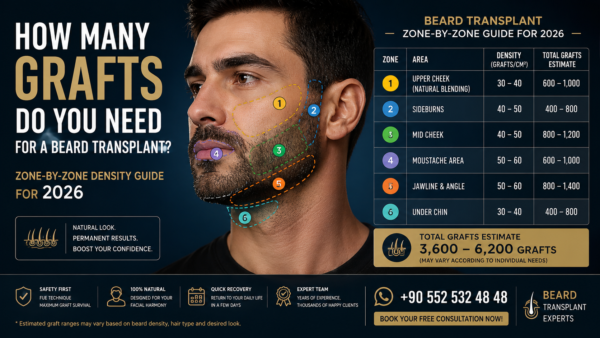
HOW MANY GRAFTS DO YOU NEED FOR A BEARD TRANSPLANT? ZONE-BY-ZONE DENSITY GUIDE FOR 2026 +905525324848
Most men researching a beard transplant ask the same question before anything else: how many grafts will I actually need? It is the single number that determines your price, your session length, your donor area usage, and how full your final result will look. Yet most clinics only give a vague range like “1,500 to 3,000 grafts” without explaining why that number changes so much from patient to patient.
The truth is that your beard is not one surface. It is five distinct zones, each with its own density requirements, growth angle, and graft cost. A patient filling in patchy cheeks needs a completely different plan than a patient building a mustache and goatee from almost nothing. Understanding this zone-by-zone breakdown before your consultation means you walk in with realistic expectations and walk out with a design that actually matches your facial anatomy.
THE FIVE BEARD ZONES AND WHY THEY MATTER
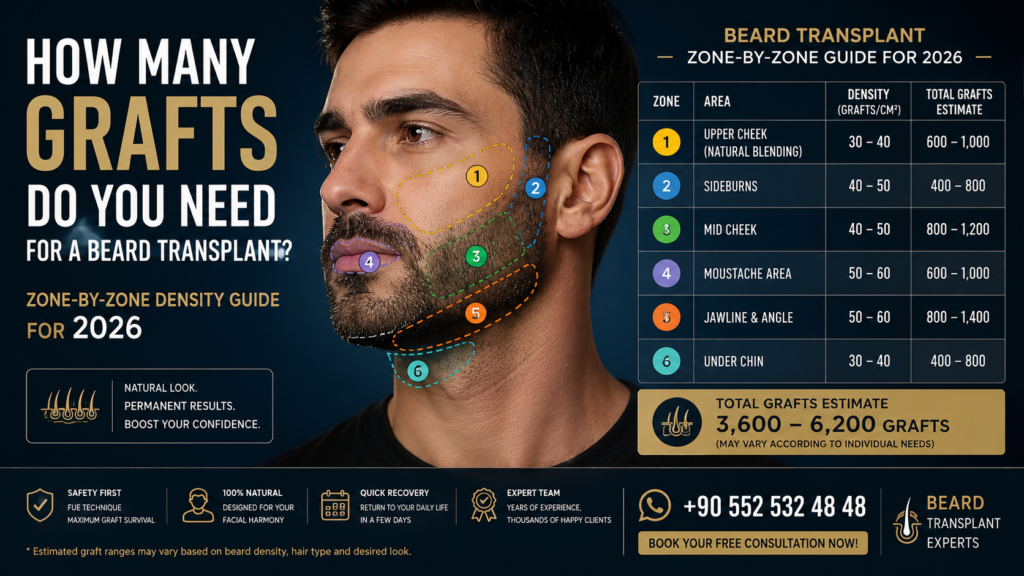
Surgeons divide the beard into five anatomical zones for planning purposes: sideburns, cheek beard, mustache, chin and goatee, and the jawline or submandibular area. Each zone has a different natural hair density, a different growth direction, and a different cosmetic priority.
Native beard hair density in men who grow facial hair naturally ranges from roughly 30 to 50 follicular units per square centimeter, varying by zone and ethnicity. A transplant does not need to match that density exactly. Because transplanted grafts are placed with precision and the surrounding native hairs help create the illusion of fullness, surgeons typically target 20 to 35 follicular units per square centimeter to achieve a cosmetically full, natural-looking beard without overloading the skin or the limited donor supply.
ZONE-BY-ZONE GRAFT REQUIREMENTS
SIDEBURNS
Each sideburn typically requires 100 to 300 grafts, depending on the length and thickness you want and how much native hair already connects toward the temple. Sideburns are considered one of the more forgiving zones to transplant, since the surrounding scalp hair naturally blends the transition.
CHEEK BEARD
The cheeks are the largest surface area of the beard and usually the most graft-intensive zone. Each cheek generally needs 350 to 900 grafts, meaning 700 to 1,200 grafts or more for both sides in patients with widespread patchiness. Growth direction changes across the cheek, moving laterally and downward, which is why this zone demands careful angle mapping rather than uniform placement.
MUSTACHE
The mustache is one of the most visible and identity-defining areas of the face, and even small inconsistencies are noticeable. It typically requires 300 to 500 grafts. Density here is usually planned slightly higher than the cheeks, and the direction of each hair must follow a precise downward angle around the cupid’s bow to avoid an unnatural, “drawn on” appearance.
CHIN AND GOATEE
The chin and goatee zone functions as the visual anchor of the entire beard and is rated by surgeons as one of the two highest cosmetic priority zones, alongside the cheek beard. It generally requires 300 to 700 grafts, with density set higher relative to the cheeks so the beard reads as full and defined from a distance.
JAWLINE
A defined jawline beard follows the mandible and is popular with patients who want a sharper facial silhouette. Grafts must be angled to follow the natural direction of hair growth along the jaw, and this zone typically needs 300 to 600 grafts depending on how far along the jawline coverage extends.
FULL BEARD VERSUS PARTIAL RECONSTRUCTION
For a complete full-beard reconstruction covering all five zones, most patients need between 1,500 and 3,500 grafts, with 2,000 to 2,500 being the most common range for moderate-to-full density. Patients with more existing native hair who are only correcting patchy sections may need as few as 800 to 1,500 grafts. Patients building a beard from near-zero facial hair, or those combining beard work with sideburn and jawline extension, sometimes require 3,000 to 4,000 grafts, occasionally split across two sessions to protect the donor area.
There is also a practical ceiling. Pushing density beyond roughly 25 to 30 follicular units per square centimeter in a single session increases the risk of poor blood supply to the grafts and reduced survival rates. An experienced surgeon will not simply implant the maximum number of grafts you can afford. They will calculate the number that gives the fullest safe result for your donor supply and skin characteristics.
DONOR AREA AND GRAFT PLANNING
Almost all beard grafts are harvested from the back and sides of the scalp, the same donor zone used for scalp hair transplants. Before finalizing your graft count, your surgeon needs to assess your total donor capacity, since a large beard transplant can meaningfully reduce the hair available if you need a scalp hair transplant later. Hair caliber, curl pattern, and color are also matched zone by zone. Coarser, straighter donor hair is typically directed to the mustache and chin for a defined look, while finer grafts are reserved for feathering the outer border of each zone so the hairline transition looks soft rather than abrupt.
FUE AND DHI EXTRACTION FOR PRECISE GRAFT COUNTS
Both FUE and DHI can be used for beard restoration, and the choice affects how grafts are counted and placed rather than how many are needed. FUE extracts follicles individually with a micro-punch tool and is generally preferred for larger zones like the cheeks, where speed and volume matter. DHI uses a pen-style implanter that places each follicle directly without a separate incision step, which allows tighter control over angle and density and is often favored for the mustache and chin, where precision has the biggest visual impact. Many patients combine both techniques within a single session, using FUE for high-volume zones and DHI for detail work around the lip line and jaw.
WHAT HAPPENS AFTER GRAFT PLACEMENT
Once the graft count and zone map are finalized and the procedure is complete, the transplanted hairs go through a predictable biological cycle. Most of the newly placed hairs shed within two to three weeks after surgery, which is a normal part of the process known as shock loss rather than a sign of failure. New growth begins around month three, and the beard continues to thicken steadily through months six to twelve, when most patients reach their final density and can judge the true result of their graft plan.
REALISTIC EXPECTATIONS AND LIMITATIONS
A higher graft number does not automatically mean a better result. Overloading a small zone like the mustache with too many grafts per square centimeter can compromise blood supply and reduce how many of those follicles ultimately survive. Patients with active alopecia areata, insufficient donor density, or unrealistic density goals relative to their donor supply are not ideal candidates for maximum graft counts, and a responsible clinic will advise a more conservative plan rather than promising a number the donor area cannot safely support.
Scarring in the beard area from acne, injury, or previous surgery can also affect how grafts take, since scar tissue has reduced blood flow compared to healthy skin. These areas often need a slightly higher graft density and a longer healing window than unaffected zones.
AFTERCARE THAT PROTECTS YOUR GRAFT INVESTMENT
Because every graft placed represents donor hair that cannot be reused, aftercare in the first two weeks is what protects the count you paid for. Avoiding shaving or trimming the transplanted area for at least ten to fourteen days, protecting the face from direct sun exposure, and following the surgeon’s cleaning routine all reduce the risk of losing grafts before they anchor. Patients who follow aftercare instructions closely tend to see final density that closely matches the number of grafts originally planted.
COST FACTORS TIED TO GRAFT COUNT
Because most Turkish clinics price beard transplants as all-inclusive packages rather than strict per-graft billing, your final graft count still drives the price tier you fall into. A partial correction of 800 to 1,500 grafts sits at the lower end of most package pricing, while a full 2,500 to 3,500 graft reconstruction moves into the higher tiers. Knowing your target zones and realistic graft range before your consultation helps you compare quotes accurately instead of comparing headline prices that may be based on very different graft counts.
WHY PATIENTS PLAN THEIR GRAFT COUNT IN TURKEY
Turkish clinics perform an exceptionally high volume of facial hair restoration procedures each year, which means surgeons have extensive zone-by-zone experience across a wide range of facial structures, hair types, and ethnic backgrounds. This volume translates into more accurate graft planning at the consultation stage, since the surgeon has likely already handled a similar density request many times before.
CHOOSING A CLINIC THAT PLANS PROPERLY
A clinic that gives you an exact graft number before ever examining your donor area and beard zones in person is guessing, not planning. Look for a clinic that maps each of the five zones individually during consultation, explains the target density per zone in follicular units per square centimeter, and is willing to say when a lower graft count is the safer and more natural choice.
CONCLUSION
Your ideal graft count is not a single number pulled from an average. It is the sum of five individually planned zones, each matched to your existing hair, your donor supply, and the density that will look proportional on your face. Understanding sideburn, cheek, mustache, chin, and jawline requirements before your consultation lets you ask sharper questions and recognize a well-planned quote from a generic one.
If you want a personalized, zone-by-zone graft estimate based on your own facial structure and donor density, reach out for a free consultation. Send a few clear photos of your current beard and donor area, and our team will map out a realistic graft plan and pricing estimate tailored to your goals.
FREQUENTLY ASKED QUESTIONS
HOW MANY GRAFTS DO I NEED FOR A FULL BEARD TRANSPLANT?
Most full beard reconstructions require between 1,500 and 3,500 grafts, with 2,000 to 2,500 being typical for moderate-to-full density across all five facial zones.
HOW MANY GRAFTS DOES THE MUSTACHE ALONE NEED?
A mustache typically requires 300 to 500 grafts to achieve a defined, natural-looking result, depending on existing hair and desired density.
CAN I GET TOO MANY GRAFTS IN ONE SESSION?
Yes. Exceeding roughly 25 to 30 follicular units per square centimeter in a single pass can reduce blood supply to the grafts and lower survival rates, which is why surgeons cap density rather than maximizing graft count.
DO SIDEBURNS OR CHEEKS NEED MORE GRAFTS?
Cheeks almost always need more grafts than sideburns because they cover a much larger surface area, typically 350 to 900 grafts per side compared to 100 to 300 for each sideburn.
WILL A LARGE BEARD TRANSPLANT AFFECT MY SCALP DONOR HAIR?
It can. Since beard grafts are harvested from the same scalp donor area used for hair transplants, a large beard session reduces the donor hair available if you need a scalp procedure later, which is why total donor capacity is assessed before finalizing your graft plan.
HOW LONG DOES IT TAKE TO SEE THE FINAL RESULT OF MY GRAFT COUNT?
Transplanted hairs shed within two to three weeks, begin regrowing around month three, and reach final density between six and twelve months after the procedure.
CAN SCAR TISSUE IN THE BEARD AREA BE COVERED WITH GRAFTS?
Yes, though scarred skin has reduced blood flow and often requires a slightly higher graft density and longer healing time to achieve full coverage compared to unaffected skin.
DOES A HIGHER GRAFT COUNT COST MORE IN TURKEY?
Yes. While many Turkish clinics quote all-inclusive packages, your graft count still determines which price tier applies, so a 3,000-graft full reconstruction will cost more than an 800-graft partial correction.
SHOULD I CHOOSE FUE OR DHI FOR A HIGH GRAFT COUNT?
FUE is generally preferred for high-volume zones like the cheeks due to faster extraction, while DHI is often used for detail-critical zones like the mustache and chin where precise angle control matters more than speed. Many surgeons combine both within one session.
WHAT IF MY DONOR AREA CANNOT SUPPORT MY IDEAL GRAFT COUNT?
Your surgeon should propose a reduced, safer graft plan focused on your highest-priority zones, such as the cheek beard and goatee, rather than overharvesting a limited donor supply.
“HOW MANY GRAFTS DO YOU NEED FOR A BEARD TRANSPLANT” üzerine bir yorum
Yorumlar kapalı.